
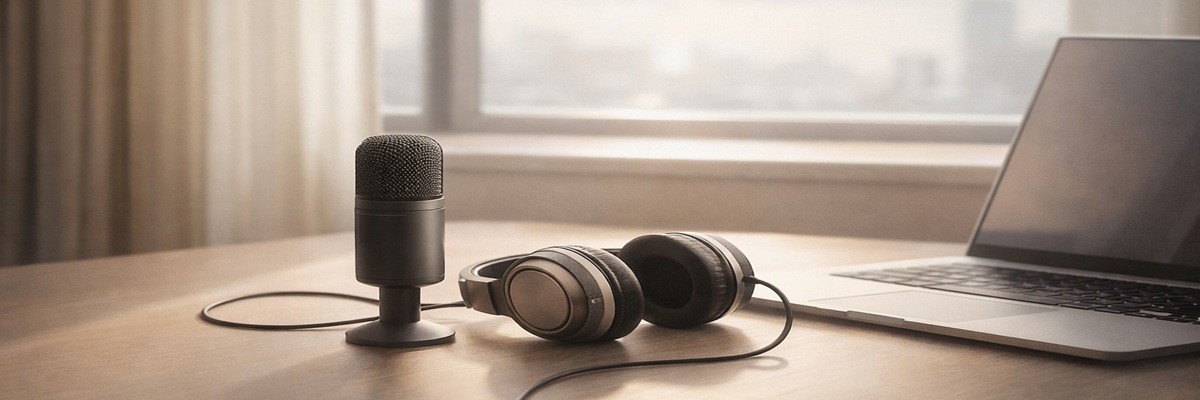
Voiceover work in 2026 looks very different from the studio-bound model that once defined the profession. Remote casting is now standard, deadlines are tighter, and many working voice actors balance home studios with travel, hybrid schedules, or temporary recording spaces. As a result, microphones designed for mobility are no longer seen as backup tools. They have become part of intentional, professional workflows.
This shift is not about lowering standards. It is about matching tools to real-world conditions. The best mobile microphones available today are designed to deliver dependable vocal quality in situations where a full studio setup is not possible. For voice actors, portability has become less about convenience and more about staying ready for work at all times.
Why Mobile Recording Is No Longer a Compromise
A few years ago, mobile recording was often framed as a last resort. A hotel audition or a quick pickup recorded on the road was treated as an exception. In 2026, those exceptions have become routine. Casting directors expect clean, usable audio regardless of where it was recorded, and many clients care more about consistency and reliability than the physical space behind the microphone.
This change has pushed voice actors to rethink what “professional” equipment looks like. Rather than chasing one perfect studio microphone, many now build flexible setups that adapt to different environments. A portable microphone is no longer an emergency solution. It is a planned part of a larger system.
That mindset shift is what has kept certain mobile microphones relevant year after year. The models gaining traction in 2026 are not defined by novelty, but by how well they integrate into working routines.
The Best Mobile and Travel-Friendly Microphones for Voice Actors in 2026
Several microphones stand out this year because they solve specific workflow problems without demanding heavy setup or technical overhead.
Compact USB and phone-compatible microphones remain popular for their simplicity. The Shure MV88 USB-C continues to earn trust among voice actors who need a reliable, pocket-sized option for narration and auditions on the road. Its strength lies in consistency. When paired with a controlled environment, even a temporary one, it delivers clear vocal capture with minimal fuss. The Sennheiser Profile USB has also gained ground as a travel-friendly option, offering a clean vocal tone and straightforward operation that suits hotel rooms and short-form recording sessions.
For actors who want consistent sound across multiple locations, hybrid microphones have become a cornerstone. The Shure MV7+, an updated evolution of the widely used MV7, remains one of the most practical choices in 2026. Its ability to function via USB or XLR allows performers to maintain a familiar vocal signature whether they are recording at home or away. That continuity matters when clients expect a recognizable sound from one session to the next.
Wireless and ultra-portable systems have carved out a different role. Tools like the RØDE Wireless PRO and DJI Mic 2 are not studio replacements, but they are increasingly used as safety nets. When a last-minute request arrives or a controlled space is unavailable, these systems provide a workable solution that keeps projects moving. Their value lies in preparedness rather than perfection.
Directional microphones also play an important role in mobile setups. The Zoom M3 MicTrak and Deity V-Mic D4 Mini are often chosen for their ability to reduce room noise in unpredictable environments. For voice actors working in untreated spaces, directional pickup can make the difference between usable audio and a missed opportunity.
What Mobile Microphones Still Cannot Replace
Despite their progress, mobile microphones have limits. They cannot fully replicate the depth, nuance, or environmental control of a well-treated studio paired with a high-end condenser microphone. Room acoustics still matter, and no portable device can completely remove the influence of an uncontrolled space.
Experienced voice actors understand this balance. Mobile microphones are chosen based on context, not as universal solutions. Long-form narration, emotionally detailed performances, or high-stakes commercial work may still call for a dedicated studio setup. Mobility does not erase those needs. It supplements them.
The key distinction in 2026 is that “best” no longer means “most expensive” or “largest.” It means most appropriate for the task at hand.
How Voice Actors Are Building Flexible Setups Today
Many professionals now work with two or three microphones, each assigned to a specific environment. One remains fixed in a treated space. Another travels. A third serves as a backup. This approach prioritizes readiness and consistency over ideal conditions.
Clients benefit from this flexibility as well. When voice actors can respond quickly without sacrificing clarity, trust builds. Over time, reliability becomes part of a performer’s reputation.
The best mobile microphones defining voiceover workflows in 2026 reflect how the industry actually functions. They support movement, adaptability, and real working lives. Portability is no longer a downgrade. It is part of what it means to be prepared for modern voiceover work.