
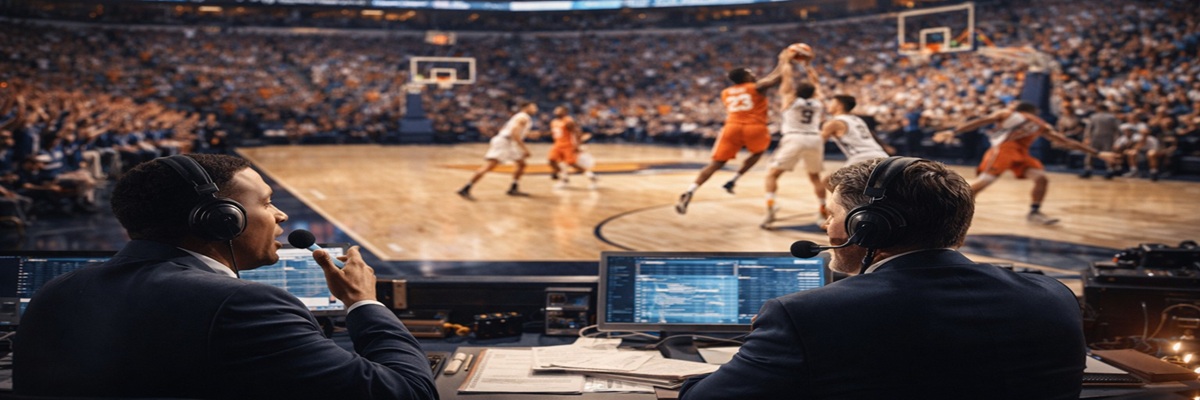
March Madness has always been about more than just basketball. Every year, the NCAA Tournament delivers dramatic finishes, unexpected upsets, and breakout performances that define college sports. While fans focus on brackets and teams, another essential part of the experience often goes unnoticed until a big moment happens. The voices calling the games shape how those moments are remembered.
For the 2026 tournament, networks including CBS, TNT, TBS, and truTV once again assembled a lineup of experienced announcers to guide viewers through one of the most unpredictable events in sports. From play-by-play calls to studio analysis, these voices help turn games into lasting memories.
The Voices of March Madness 2026
The NCAA Tournament is one of the most complex live broadcasts in sports. With games happening across multiple networks and time slots, the role of announcers becomes even more important. Each broadcast team is responsible for delivering clear, engaging commentary while reacting to the fast pace of tournament play.
Among the leading teams this year are Ian Eagle, Bill Raftery, Grant Hill, and Tracy Wolfson, a group known for its chemistry and ability to balance insight with energy. Eagle handles play-by-play duties, while Raftery and Hill provide analysis, breaking down plays and offering perspective on the action.
Another major broadcast team includes Kevin Harlan, Dan Bonner, Stan Van Gundy, and Lauren Shehadi. Harlan’s energetic delivery has made him one of the most recognizable voices in sports broadcasting, and his ability to elevate big moments fits perfectly with the intensity of March Madness.
Brian Anderson, Jim Jackson, and Allie LaForce form another key group, bringing a mix of experience and strong on-court reporting. Their coverage often focuses on storytelling, giving viewers context about players and teams as the tournament unfolds.
Additional teams such as Andrew Catalon, Steve Lappas, and Evan Washburn, along with Spero Dedes, Jim Spanarkel, and Jon Rothstein, round out the coverage, ensuring that every game receives the same level of professional commentary.
In the studio, Ernie Johnson, Charles Barkley, Kenny Smith, and Clark Kellogg lead the analysis. Their discussions between games provide insight, humor, and reactions that help viewers follow the larger tournament picture.
Together, these announcers create a consistent voice across a tournament that spans multiple channels and dozens of games.
What Makes a Great Live Sports Announcer
Live sports announcing requires a unique set of skills that go beyond simply describing what is happening on the court. Announcers must react instantly to plays, adjust their tone based on the situation, and communicate clearly to a wide audience.
Play-by-play commentators like Ian Eagle and Kevin Harlan focus on delivering the action in real time. Their job is to keep the audience informed while maintaining excitement, especially during fast breaks or last-second shots. Color commentators such as Bill Raftery and Grant Hill add depth by explaining strategy, player decisions, and game dynamics.
Chemistry between announcers is just as important as individual skill. When teams work well together, the broadcast feels natural and engaging. This is particularly important during March Madness, where games can shift quickly and emotions run high.
The tournament is known for its dramatic finishes, including buzzer-beaters and unexpected upsets. In these moments, the announcer’s voice becomes part of the memory. A well-timed call can elevate a play into something iconic, while poor delivery can lessen the impact of the moment.
This is why networks rely on experienced voices for the tournament. Announcers must be prepared for anything, from routine plays to once-in-a-lifetime highlights.
March Madness 2026: Tournament Overview and Key Storylines
The NCAA Tournament follows a single-elimination format, meaning every game carries high stakes. Teams have no margin for error, and one loss ends their season. This structure is what makes March Madness one of the most unpredictable events in sports.
The 2026 tournament features a mix of top seeded programs and lower seeded teams looking to create upsets. Early rounds often produce surprising results, as underdog teams take advantage of the pressure faced by higher ranked opponents.
As the tournament progresses, the intensity increases. Each round brings teams closer to the Final Four, where the remaining contenders compete for a national championship. Along the way, individual performances and team dynamics become major storylines.
For viewers, the appeal lies in the unpredictability. No bracket remains perfect for long, and every game has the potential to produce a memorable moment. This unpredictability places even greater importance on the announcers, who must be ready to capture those moments as they happen.
Why Live Announcers Are Central to the March Madness Experience
Announcers are the connection between the game and the audience. Their voices guide viewers through every possession, every run, and every turning point. Over the course of the tournament, these voices become familiar companions for fans following multiple games each day.
In many cases, the call of a game becomes inseparable from the moment itself. A buzzer-beater or a game-winning shot is often remembered not just for the play, but for how it was described in real time.
March Madness continues to highlight the importance of live announcing in sports broadcasting. With so many games and so much unpredictability, the ability to deliver clear, engaging, and timely commentary remains essential.
As the 2026 tournament unfolds, the players and teams will determine the results on the court. But the voices behind the broadcast will shape how those moments are experienced and remembered by millions of viewers.