
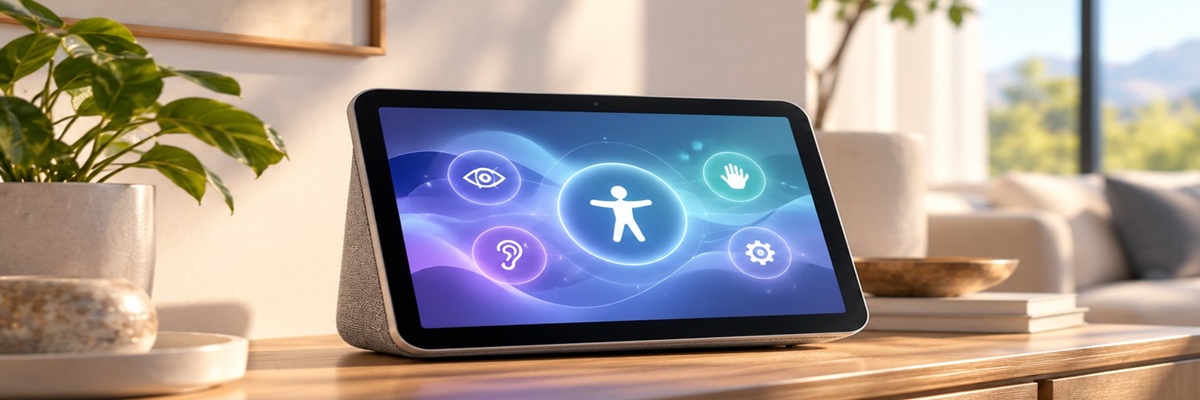
Apple is expanding its accessibility technology into the smart home with HomeView, a new smart display featuring a range of speech-based and assistive controls. The device includes 12 accessibility features, with VoiceOver, Live Speech, Voice Control, and Siri among the options designed to make everyday interactions more accessible to users with different needs.
Scheduled for release on November 13, 2026, at a starting price of $299, HomeView combines touchscreen interaction with spoken feedback and voice commands. The device represents another step in Apple’s efforts to make its technology accessible across different product categories, extending familiar features from the iPhone, iPad, and Mac into a centralized smart home interface.
HomeView Expands Voice-Based Accessibility
One of the key accessibility features included in HomeView is VoiceOver, Apple’s built-in screen reader that provides spoken descriptions of interface elements and other information displayed on screen. The technology allows users with visual impairments to navigate digital interfaces through audio feedback rather than relying entirely on visual information. Its inclusion in HomeView brings that functionality to a device intended for controlling connected home technology.
HomeView also supports Live Speech, which allows users to type messages and have them spoken aloud through the device. The feature is particularly useful for people who experience difficulty speaking or who use alternative communication methods. By converting written text into synthesized speech, Live Speech provides another way for users to communicate without depending on their natural speaking voice.
Voice Control offers a different form of accessibility by allowing users to operate the interface through spoken commands. Rather than requiring physical interaction with the touchscreen, the feature enables users to navigate and perform actions using their voices. Siri and Dictation provide additional speech-based functionality, while Vocal Shortcuts allow users to trigger specific actions through customized vocal inputs.
Together, these capabilities give HomeView several ways to support hands-free operation and spoken interaction. The combination is particularly relevant for a smart home device, where users may need to access information or manage connected equipment without directly touching the display.
Apple Builds on Earlier AI Accessibility Updates
HomeView’s accessibility features follow a series of announcements Apple made earlier in 2026 concerning artificial intelligence and assistive technology. In May, the company outlined improvements intended to make its devices easier to navigate and operate for people with disabilities, including enhancements involving VoiceOver and Voice Control.
Among the developments were more detailed image descriptions through VoiceOver, supported by Apple Intelligence. These improvements were designed to help users understand visual content through spoken explanations, extending the screen reader’s capabilities beyond conventional interface navigation. Apple also introduced improvements to Voice Control that allow users to issue commands using more natural language, reducing the need to memorize specific instructions.
These earlier announcements reflect Apple’s growing use of AI to improve the relationship between spoken language and digital interfaces. Instead of relying exclusively on fixed commands or predefined descriptions, newer accessibility technologies can interpret more complex information and provide responses that are easier for users to understand.
Although HomeView’s accessibility features are part of the same broader ecosystem, Apple has not indicated that every AI-powered capability announced for its other devices will necessarily be available on the smart display at launch. The confirmed HomeView features nevertheless demonstrate how established speech technologies are being extended into additional product categories.
HomeView Brings Accessibility Into the Smart Home
The introduction of HomeView places speech accessibility at the center of a device designed for everyday household use. Smart displays commonly serve as interfaces for controlling connected devices, checking information, and managing household activities. For users who cannot comfortably rely on touchscreens or visual menus, spoken feedback and alternative input methods can make these functions considerably easier to access.
Apple’s approach also extends across its wider home technology lineup. Accessibility options are included in products such as Apple TV and HomePod, where voice interaction and spoken feedback already play important roles. HomeView adds a dedicated visual interface while retaining multiple methods of interaction, giving users greater flexibility in how they operate their smart home technology.
The inclusion of both VoiceOver and Live Speech is particularly significant because the two features address different accessibility needs. VoiceOver converts interface information into spoken feedback, while Live Speech converts typed communication into audible speech. Combined with Voice Control and Siri, they demonstrate how speech synthesis and voice recognition can support accessibility from different directions.
With HomeView scheduled to arrive in November, Apple’s latest smart home device will bring several established accessibility technologies into a new setting. Its combination of spoken feedback, synthesized speech, and voice-based controls highlights the continuing importance of speech technology in making connected devices more accessible.