
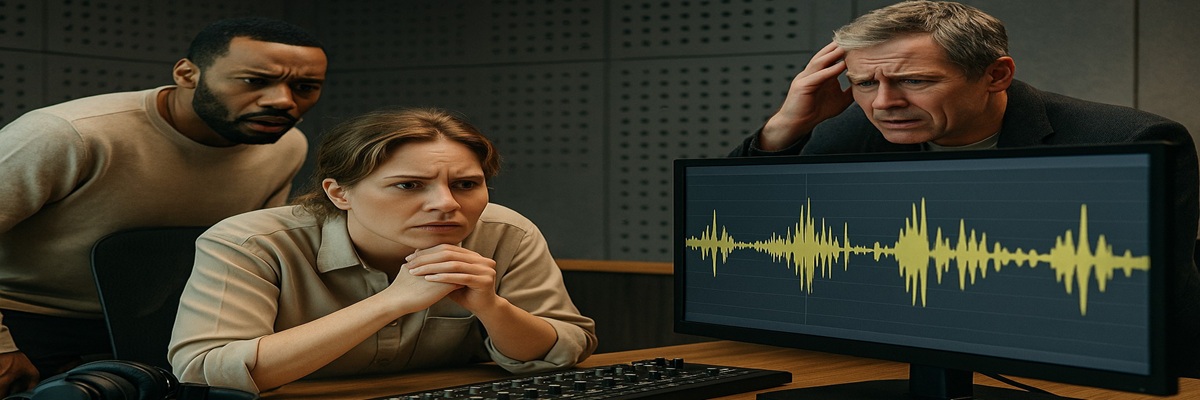
The discussion around synthetic voice tech is everywhere, but one recent campaign approached the topic with a different angle. Instead of sounding worried or technical, the short film employed comedy to illustrate what happens when a computer-generated narrator completely spirals off track. The spot begins with a standard commercial read that feels polished but slightly flat. As the piece moves forward, the synthetic voice loses control, picking up strange emotional cues, incorrect words, and chaotic timing that would stall any recording session. The entire sequence becomes more unhinged with every line, turning a routine script into a moment of pure confusion for the studio team inside the film.
What makes this approach work is how it reflects the growing conversation in the voice community. Synthetic systems have improved in clarity, tone matching, and rhythm. However, the film highlights what is still missing: judgment, emotional depth, and instinct. A seasoned performer understands why a line needs warmth, tension, or humor. A predictive engine can mimic sound patterns, but it rarely understands why the shift is required. The humor in the film is rooted in that gap. The more the system misinterprets the tone, the more the viewer is reminded of how important human presence is.
Beneath the comedy sits a sincere message. The film pushes the synthetic narrator to levels that border on absurd, yet that exaggeration underscores a simple truth. Creative decisions thrive on collaboration, context, and feeling. Those elements guide every strong voice performance. A synthetic tool can generate a sound, but not an intention. Instead of condemning new tech, the film offers a reminder of what makes human storytelling special: timing, adaptability, and emotional clarity.
The Human Factor That Tech Cannot Recreate
Recording sessions often depend on subtle shifts that happen in real time. A director may ask for a tone that leans gentler or more confident. A trained performer can make that adjustment instantly. The synthetic voice in the film misses every cue, stumbling through each shift in a way that highlights how vital that collaborative exchange is. The contrast is sharp and crafted to balance comedic timing.
The campaign quietly speaks to a broader truth in media production. High-quality work grows from cooperation, understanding, and emotional intelligence. Even as synthetic voice tools become more common, they serve as enhancements, not replacements. They support quick demos, internal scratch tracks, and fast turnaround needs, but they lack the expressive insight that actors bring from personal experience.
The message that lingers after the final joke is simple and grounded. When a voice carries feeling, it forms a connection with the listener. When it feels mechanical, even the strongest script loses impact. The campaign reinforces that storytelling is a human exchange. Synthetic systems can process words, but people give those words intention and warmth. For performers, directors, and producers, the film is both entertaining and reassuring. It reminds the industry that while technology may shift how projects are made, authentic performance remains central to any story that seeks to move an audience.