
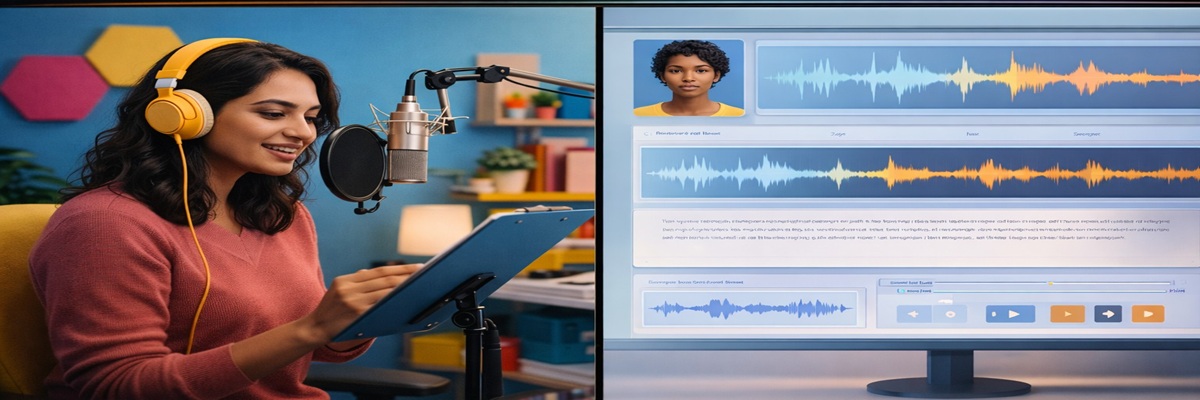
AI-generated voices are no longer experimental. They are already being used in training modules, internal tutorials, and instructional content across multiple industries. In educational voiceover, this shift has been gradual rather than disruptive, building alongside the growth of digital learning itself.
For companies producing large volumes of training content, automation offers speed and scalability. For voice actors, it introduces new questions about where human narration fits within an evolving workflow.
The reality sits somewhere in between. AI is not replacing educational voiceover, but it is changing how and where it is used.
Where AI Voice Is Already Being Used in eLearning
AI narration has found its strongest foothold in areas where efficiency matters more than performance.
Corporate training is one of the clearest examples. Large organizations regularly update internal materials, including compliance modules, onboarding programs, and software training. These updates often need to be produced quickly, sometimes across multiple regions at once. AI-generated voices allow companies to make those changes without scheduling recording sessions or coordinating with multiple vendors.
Microlearning content has also become a key area for automation. Short, focused modules designed to deliver quick pieces of information are well suited to AI narration. The structure is simple, the tone is functional, and the need for emotional nuance is limited.
Multilingual training is another driver. AI tools can generate narration in multiple languages at scale, helping companies distribute content globally without significantly increasing production time or cost.
In these scenarios, the priority is speed and consistency. AI performs well when the content is repetitive, structured, and focused on delivering information rather than creating an experience.
Where Human Voice Still Holds Its Ground
Despite these advances, there are clear areas where human voice actors remain essential.
Educational content often involves more than delivering information. It requires guiding the listener through complex ideas, maintaining attention over longer periods, and creating a sense of trust. These elements depend on subtle variations in tone, pacing, and emphasis that AI still struggles to replicate.
Technical and medical training are strong examples. In these fields, clarity is critical, but so is the ability to adjust delivery based on context. A slight shift in emphasis can change how information is interpreted. Human narrators can make those adjustments naturally. Many organizations still invest in professional narration, corporate training specialists, and high-quality eLearning voiceover because audience retention often depends on how naturally information is delivered.
External-facing courses also tend to rely on professional voiceover. Platforms like Coursera and LinkedIn Learning invest in high-quality production because their content is part of a broader learning experience. A natural, engaging voice helps maintain credibility and encourages continued listening.
There is also the question of listener perception. A human voice often feels more trustworthy and easier to follow, particularly in longer sessions. While AI voices have improved significantly, they can still sound uniform over time, which may lead to fatigue.
These differences are not always obvious in short segments, but they become more noticeable as the length and complexity of the content increase.
The Hybrid Workflow Taking Shape
Rather than replacing human narration, AI is becoming part of a hybrid production model.
In many cases, companies are using AI for early-stage or internal content while reserving human voice actors for final versions or public-facing materials. This approach allows them to balance efficiency with quality.
For example, a training department might use AI narration to quickly prototype a module. Once the content is finalized, a voice actor records the finished version, ensuring consistency and clarity. In other cases, AI may handle routine updates, while human narration is used for core sections of a course.
This hybrid workflow reflects how educational content is produced at scale. Not every piece of material requires the same level of polish, but key sections still benefit from professional voiceover.
The result is not a shift away from voice actors, but a redistribution of where their work is most valuable.
What Voice Actors Need to Understand Moving Forward
For voice actors working in educational narration, the growth of AI highlights the importance of positioning.
The areas most affected by automation tend to be those where delivery is purely functional. Scripts that require minimal variation or interpretation are easier to replicate with AI tools. This makes it important for voice actors to focus on work that demands a higher level of skill.
Complex subject matter, long-form narration, and externally facing content continue to rely on human performance. These areas require clarity, adaptability, and an understanding of how listeners process information over time.
Building strong client relationships also becomes more important. Companies that value consistency and quality are more likely to continue working with human narrators, particularly for content that represents their brand.
Another factor is specialization. Voice actors who understand instructional design, pacing, and audience needs are better positioned to offer something beyond basic narration. The more a performer aligns with the goals of the content, the less interchangeable their role becomes.
This shift does not reduce opportunities. It changes where those opportunities exist.
AI has become part of the educational voiceover landscape, but it has not replaced the need for human voices.
Training content continues to grow, and with it, the demand for clear, effective communication. Automation may handle certain tasks more efficiently, but the qualities that define strong narration, clarity, nuance, and trust, remain tied to human performance.
As the industry evolves, educational voiceover is not disappearing. It is adapting, with voice actors continuing to play a central role in how people learn and understand information.