
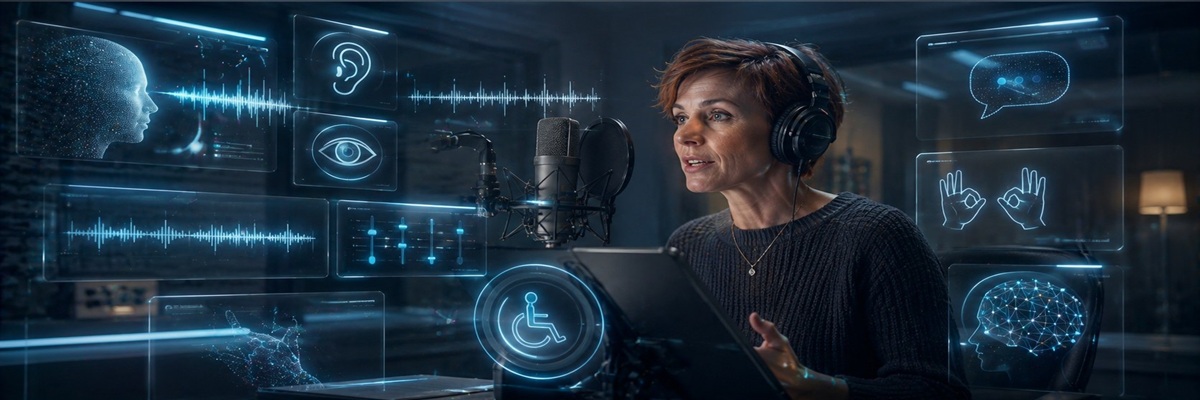
Apple’s Accessibility Push Shows Where Human Voice Performance Still Matters
Apple’s newest accessibility announcements arrived with the usual headlines about artificial intelligence, smarter assistants, and more natural interactions. Hidden beneath the broader Apple Intelligence rollout, however, was something especially relevant to the voiceover industry: a renewed focus on spoken accessibility tools, AI-assisted communication, and voice-driven user experiences.
The company introduced updates tied to Voice Control, VoiceOver, Magnifier, Accessibility Reader, and other assistive technologies designed to help users navigate devices more naturally. Many of these systems rely heavily on synthesized speech, contextual recognition, and spoken interaction. For some in the voiceover industry, announcements like these immediately raise familiar questions about automation and whether synthetic speech systems are slowly replacing human vocal work.
Yet Apple’s latest direction may actually reinforce something professional voice actors have argued for years. Functional AI speech and human voice performance are not the same thing. In many ways, these new accessibility features highlight the growing difference between utility-driven machine speech and emotionally intelligent vocal storytelling.
Accessibility Technology Is Expanding, But So Is the Need for Human Communication
Apple’s latest accessibility features are built primarily around usability. The tools focus on helping users read, navigate, identify objects, interpret surroundings, and communicate more efficiently through spoken interaction. The company also emphasized on-device processing and contextual awareness, which allows systems to respond faster while preserving privacy.
That matters because accessibility technology has become one of the fastest-growing areas in consumer tech. Millions of users depend on screen readers, voice navigation, speech recognition, subtitles, audio assistance, and adaptive interfaces every day. As these systems improve, companies increasingly need spoken experiences that sound natural, clear, and easy to understand.
But clarity is not the same as performance.
The voices used in accessibility systems are typically designed for consistency, neutrality, and comprehension. They are engineered to deliver information efficiently. That is very different from the work performed by voice actors in animation, games, audiobooks, documentaries, commercials, or cinematic narration.
A navigation prompt does not require dramatic timing. A screen reader does not interpret emotional subtext. Accessibility prompts are designed to assist users, not perform for audiences.
That distinction is important because it suggests Apple’s rollout is not directly competing with entertainment-based voice acting. Instead, it reflects the broader expansion of voice as an interface.
For voice professionals, that expansion may create new categories of work rather than eliminate existing ones.
As accessibility standards continue improving across apps, websites, streaming platforms, education platforms, and public services, companies are investing more heavily in spoken content. That includes audio description, multilingual narration, training materials, educational voiceover, guided experiences, and accessibility-first media production.
Many of those areas still benefit significantly from human narration because accessibility is not only about information delivery. It is also about pacing, warmth, clarity, tone, and listener comfort over long periods of time.
The Difference Between Utility Speech and Voice Acting Is Becoming More Visible
One of the most interesting aspects of Apple’s accessibility rollout is how clearly it separates functional speech from expressive performance.
For years, conversations around AI voices often treated all spoken audio as interchangeable. The assumption was that if a computer could “talk,” it could eventually replace most forms of voice work. The reality has proven far more complicated.
Synthetic voices have become highly effective in structured environments. They can read directions, summarize text, answer simple questions, and assist with device navigation. Those tasks depend heavily on speed and consistency.
Performance voiceover depends on interpretation.
A character performance in an animated series requires acting choices, emotional rhythm, comedic timing, and personality. Audiobook narration requires pacing and character differentiation over several hours. Commercial reads depend on persuasion, trust, authenticity, and brand tone. Video game performances often involve improvisation, emotional escalation, and collaborative direction.
Even highly advanced synthetic speech systems still struggle with many of these qualities because human performance is shaped by lived experience, emotional instinct, and creative decision-making.
Apple’s new accessibility tools unintentionally reinforce this separation. The company is not advertising these voices as replacements for actors or narrators. Instead, it is positioning them as tools for assistance and navigation.
That framing matters.
The more consumers interact with functional AI speech, the more they may begin recognizing the difference between utility audio and artistic performance. In some ways, the rapid growth of synthetic accessibility voices could make professionally performed narration feel even more valuable because audiences can hear the contrast more clearly.
There is also an important trust factor involved. Human voices still carry emotional credibility in ways that machine-generated speech often does not. That becomes particularly important in storytelling, healthcare communication, educational material, and long-form listening experiences.
Accessibility Could Become a Bigger Voiceover Opportunity Than Many Realize
One overlooked aspect of the accessibility conversation is that inclusive design often creates entirely new production needs.
As platforms improve accessibility support, they frequently add:
- audio description tracks
- multilingual narration
- adaptive learning narration
- guided accessibility tutorials
- spoken onboarding systems
- accessibility-first educational content
These areas continue expanding across streaming services, gaming platforms, mobile applications, museums, public institutions, and online education systems.
Many companies initially experiment with automated systems because they are fast and inexpensive. Over time, however, organizations often discover that users respond more positively to voices that sound comfortable, conversational, and emotionally aware.
That is especially true for long listening sessions. Users relying on accessibility narration may spend hours interacting with spoken systems every day. Listener fatigue becomes a real issue. Vocal warmth, pacing, pronunciation, and tonal balance matter far more in extended use than many technology companies initially expect.
This creates a potential opening for voice professionals who specialize in:
- clear instructional narration
- accessibility-friendly reads
- educational voiceover
- calm conversational delivery
- multilingual localization
- adaptive narration for assistive platforms
The conversation around AI and voice acting often focuses almost entirely on replacement fears, but accessibility may evolve into one of the strongest areas for collaboration between technology companies and trained voice talent.
That does not mean industry concerns disappear. Voice actors still have legitimate questions about consent, voice replication, compensation, and ethical AI development. Those debates will continue as synthetic speech systems improve.
At the same time, Apple’s latest accessibility rollout suggests the industry may be entering a more nuanced phase than many expected.
Instead of one system replacing another outright, the market may be dividing into separate categories:
- functional utility speech
- assistive communication
- expressive performance
- cinematic storytelling
- human-centered narration
Voice actors remain strongest in the areas where emotional interpretation matters most.
Apple’s accessibility push may ultimately serve as a reminder that the future of spoken media is not simply about whether machines can generate speech. It is about understanding why human voices still connect with people differently.