
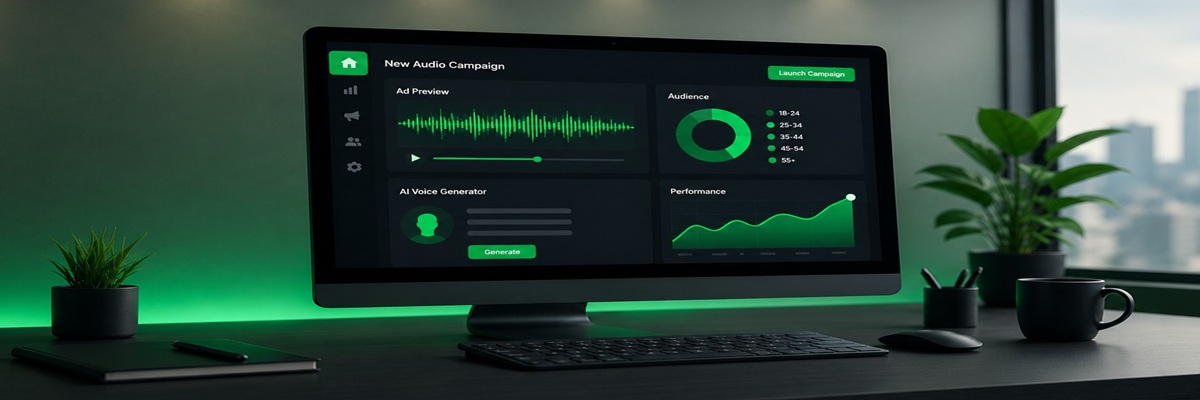
Spotify is continuing its push to modernize digital advertising, and artificial intelligence is becoming a larger part of that strategy. Recent reports indicate the company is expanding its advertising business by investing in automation, AI-powered campaign tools, and AI-generated voiceovers designed to simplify audio ad production for advertisers.
The latest developments build on Spotify’s advertising platform updates announced earlier this year, when the company introduced new tools intended to make buying, creating, and measuring campaigns faster and more accessible. Those updates included expanded automation, a redesigned self-service platform, and the rollout of Spotify Ad Exchange (SAX), giving advertisers greater flexibility when placing audio and video ads across the streaming service.
While many of these features are aimed at improving efficiency for marketers, the addition of AI-generated voiceovers has also drawn attention from the voiceover industry. As advertisers gain new ways to produce audio campaigns without traditional recording sessions, questions naturally arise about how automation may influence commercial voice work in the years ahead.
Spotify’s Advertising Platform Continues to Evolve
Spotify’s recent advertising initiatives reflect a broader effort to compete more aggressively for digital advertising budgets.
In April, the company announced significant updates to Spotify Ads Manager and introduced Spotify Ad Exchange, a programmatic marketplace designed to make purchasing advertising inventory more efficient. The platform also added new measurement capabilities and expanded creative tools intended to reduce the complexity of producing campaigns.
The goal is straightforward. Spotify wants advertisers of all sizes to move from campaign planning to publication more quickly while relying less on manual production processes.
For smaller businesses in particular, traditional audio advertising has often required multiple production steps, including script development, hiring voice talent, recording sessions, editing, and final delivery. Spotify’s new platform attempts to streamline much of that workflow by integrating creative tools directly into its advertising ecosystem.
This approach reflects a larger trend across digital advertising, where automation is increasingly being used to reduce production time and simplify campaign management.
AI Voiceovers Become Part of the Platform
One of the most closely watched additions to Spotify’s advertising strategy is the integration of AI-generated voiceovers.
According to recent reporting, advertisers using Spotify’s platform can generate narrated advertisements through AI rather than recording them with a human voice actor. Combined with automated production tools, this allows businesses to create audio advertisements more quickly and with fewer production requirements.
The feature is primarily designed to help advertisers who may not have the budget, resources, or production expertise to create traditional radio-style commercials. Instead of booking studio time or hiring professional voice talent, users can generate narration directly within the advertising platform.
For Spotify, the move fits naturally alongside its broader investment in automation. AI-generated voiceovers become another production tool available to advertisers already using automated campaign creation, audience targeting, and performance measurement.
The company’s objective appears to be improving accessibility rather than replacing every aspect of traditional commercial production. Many advertisers value speed, particularly when producing local promotions, seasonal offers, or campaigns that need frequent updates. Automated voice generation offers an option for situations where turnaround time may be more important than custom performance.
What This Means for Commercial Voice Actors
Spotify’s announcement has naturally attracted attention throughout the commercial voiceover community.
Audio advertising has long been one of the largest areas of employment for professional voice actors. National campaigns, regional promotions, streaming ads, podcast sponsorships, and local business commercials all rely on narration to communicate brand identity and connect with listeners.
AI-generated voiceovers introduce another production option into that landscape.
For smaller advertisers, automated narration may provide an affordable way to launch campaigns that might never have included professional voice talent in the first place. Businesses with limited budgets or short production schedules may find value in self-service tools that allow advertisements to be produced within minutes.
At the same time, many premium brands continue to invest heavily in human performance. National campaigns frequently depend on voices capable of delivering emotion, personality, subtle timing, and brand consistency that remain difficult for synthetic voices to reproduce convincingly.
Commercial voice actors also bring creative collaboration to a project. Directors often adjust pacing, emphasis, tone, and delivery during recording sessions to achieve a specific marketing objective. That collaborative process remains an important part of many high-profile advertising campaigns.
Rather than creating a single outcome for the industry, Spotify’s approach may further divide the market between automated production for high-volume advertising and professionally produced campaigns where human performance remains a defining element.
Automation Is Reshaping Audio Advertising
AI voiceovers are only one part of Spotify’s broader advertising strategy.
The company is investing in automation across multiple stages of campaign production. Advertisers can increasingly manage targeting, purchasing, measurement, optimization, and creative production through integrated digital tools rather than relying on multiple outside vendors.
This reflects wider changes occurring throughout the advertising industry.
Programmatic buying has transformed how digital inventory is purchased. Dynamic ad insertion allows campaigns to reach different audiences based on geography, demographics, or listening habits. Performance analytics provide near real-time feedback that can influence campaign adjustments while advertisements are still running.
Adding AI-assisted creative production completes another step in that automated workflow.
For advertisers, the benefits include faster production, simplified campaign management, and the ability to react quickly to changing business needs. Seasonal promotions, limited-time offers, and localized campaigns can be updated far more rapidly than under traditional production models.
As automation becomes more common, audio advertising is increasingly moving toward a production environment where technology assists both the creative and operational sides of campaign development.
The Debate Around AI Voices Continues
Spotify’s expanding advertising platform illustrates how quickly AI is becoming part of mainstream marketing technology.
The company’s investment in automation and AI-generated voiceovers reflects growing demand from advertisers seeking faster production workflows and greater control over campaign creation. For many businesses, these tools represent another option for reaching audiences efficiently.
At the same time, professional voice actors continue to play an essential role in advertising where storytelling, emotional connection, and brand identity remain priorities. Human performance brings interpretation, adaptability, and creative nuance that many advertisers still value for high-profile campaigns.
As AI tools become more widely available, the conversation is likely to shift away from whether automation will be used and toward how it will coexist with traditional voiceover work. Spotify’s latest advertising strategy adds another chapter to that discussion, highlighting both the opportunities technology creates for advertisers and the evolving questions it raises for the commercial voiceover industry.