
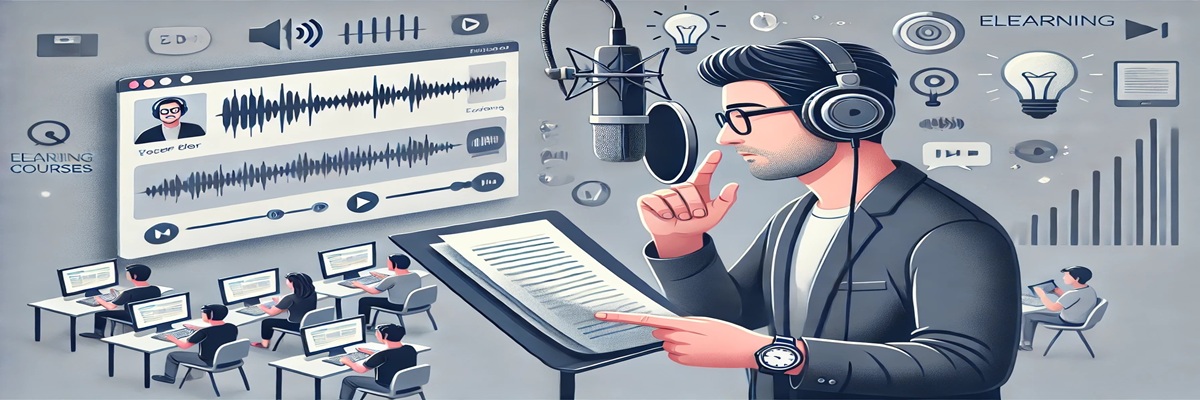
In the world of eLearning, content must do more than simply inform — it must teach effectively. While instructional designers handle the structure and pedagogy, the voiceover artist is responsible for translating written words into a spoken experience that supports learner engagement and comprehension. This requires a specific type of performance — one that may differ significantly from commercial, animation, or audiobook work.
For voice actors, adapting your delivery to meet instructional goals isn’t just a stylistic choice — it’s a functional necessity. The success of an eLearning module often depends on how well your voice reinforces the learning environment. In this article, we explore how voiceover performance shapes learner outcomes, and what you can do to make your narration a true asset to instructional design.
Why eLearning Requires a Different Performance Approach
eLearning narration operates in a unique space. Unlike entertainment or advertising, where the goal is often to capture attention or sell an idea, eLearning narration is about facilitating understanding. Your voice needs to support the learner without distracting them from the content.
Instructional designers often work from learning theories such as Mayer’s Cognitive Theory of Multimedia Learning, which emphasizes reducing extraneous cognitive load. If your performance is overly animated or emotionally charged, it can compete with the content rather than complement it. On the other hand, a flat, disengaged delivery can make even the most carefully designed course feel lifeless.
In short, the goal isn’t to perform — it’s to communicate. And to do that well, you must understand the instructional intent behind the script.
Tone and Delivery Should Align With Content Type
There’s no one-size-fits-all approach to eLearning narration. The tone, pacing, and energy level should reflect the type of training and its intended audience.
For example, compliance training often requires a calm, neutral tone that emphasizes clarity and seriousness. Soft skills courses, by contrast, may benefit from a warmer, more conversational delivery that feels approachable and human. Technical training might call for a confident, deliberate cadence that assures the learner they’re in capable hands.
Clients don’t always articulate this clearly, but they often know when something feels “off.” As a voice actor, being able to read the context of the material — and adjust your tone accordingly — is a skill that sets you apart.
Pacing Affects Comprehension
In instructional settings, pacing is a performance variable with real pedagogical consequences. Read too quickly, and learners may miss key information. Read too slowly, and the course may feel plodding and tedious.
This is especially important in self-paced eLearning environments, where learners are often consuming content independently. Unlike in a live classroom, there’s no opportunity to stop and clarify. Your pacing must be intuitive enough to allow learners to absorb information at a natural rhythm.
Many clients will not give you precise direction on pacing — they expect you to know what’s appropriate. This is where experience in eLearning voiceover makes a measurable difference.
Emotional Neutrality vs. Engagement
One of the most misunderstood aspects of eLearning voiceover is the balance between emotional neutrality and engagement. Instructional narration shouldn’t sound robotic, but it also shouldn’t draw attention to itself with excessive drama or stylization.
The best performances in eLearning are often transparent — the listener doesn’t notice the voice per se, but they stay focused, relaxed, and receptive to the content. It’s a restrained kind of engagement, where warmth and clarity do more work than inflection or flair.
That doesn’t mean you need to sound “flat.” Rather, think of your delivery as anchoring the material, not embellishing it. Authenticity, comfort, and trust are more valuable than theatrical range in this context.
Pronunciation and Precision
Another area where instructional performance differs from other genres is in the precision of language. Technical terms, industry jargon, acronyms, and brand-specific names are common in eLearning scripts. These must be pronounced accurately and consistently.
Instructional designers often provide reference materials or pronunciation guides, but when they don’t, it’s your responsibility to research unfamiliar terms. Re-records due to pronunciation errors can delay course production and reduce client confidence in your professionalism.
Additionally, eLearning scripts are typically written with tight alignment to visuals or screen text. This means you need to stay word-accurate — no improvising, no rephrasing, and no “polishing” the copy, even if you think it would sound better. Your job is to execute the narration exactly as written.
How Scenario-Based Learning Changes the Game
While much of eLearning uses straightforward narration, there’s a growing use of scenario-based learning to simulate real-world environments. These modules often include decision-making trees, interactive dialogues, or branching storylines.
In these cases, your performance may shift closer to character work — but even then, subtlety is key. You might be portraying a frustrated customer, a supportive manager, or a concerned co-worker. These characters require tone variation and emotional range, but still within the bounds of realism and clarity.
Overacting in these scenarios can ruin immersion. Underacting, on the other hand, may make the scenario feel artificial or unhelpful. Your task is to strike a believable balance that fits the instructional tone of the course.
Taking Direction and Adapting on the Fly
Clients in eLearning often aren’t trained in directing voice talent. Their feedback may be vague, such as “Can you make it sound more natural?” or “It feels a little too fast.” As a professional, your ability to interpret client feedback and adjust your delivery accordingly becomes part of your value.
A good eLearning voice actor listens carefully to what’s being asked — and what isn’t — and makes changes that address the underlying instructional goal. If you can adapt without resistance, clarify when needed, and offer variations quickly, you become more than a voice — you become a reliable creative partner.
The Instructional Lens: Your Silent Co-Star
Think of instructional design as your silent co-star in every eLearning project. It sets the stage, builds the pacing, and determines what learners need to know and retain. Your voiceover is not a solo act — it’s part of a larger instructional performance.
When you understand how learning outcomes shape the script, you’re able to deliver narration that aligns perfectly with the course’s purpose. That’s what separates experienced eLearning voice actors from generalists.
Final Thoughts
Voiceover in eLearning is both an art and a craft — but it’s also a service. Your performance must serve the learner, the designer, and the learning objective. Adapting your delivery style, tone, and pacing to meet instructional goals is a skill that grows with experience and intention.
The more you understand the logic behind the script — and the learning needs of your audience — the more valuable you become to eLearning clients. In this space, great narration doesn’t just sound good. It teaches well.